


03 Nov A Story of Grief and Growth: An SUDC Sibling’s Reflection
A Story of Grief and Growth: An SUDC Sibling’s Reflection
By Jordan Young

November is Worldwide Bereaved Sibling Month, a time to honor the irreplaceable bond between siblings and the ongoing journey of those who live with loss. Jordan Young, sibling of Casey Young who passed away in 2011, offers a moving reflection on what it means to carry a sister’s memory while also learning to live fully in her own light. In her journey, Jordan has confronted the weight of survivor’s guilt: the tension between remembrance and self-discovery: and, in doing so, Jordan has found the courage to give herself permission to be her own person.
Now a digital producer at NBC Washington covering healthcare and disability, Jordan continues to channel her experiences into storytelling and advocacy. Through her perspective, she reminds us that grief, while uninvited, can become a profound teacher—revealing not only the depths of our love but also the resilience and meaning that can emerge from it.
Despite being a whole seven years apart, my little sister, Casey, and I had a lot in common. We both loved dancing, playing dress up and doing arts and crafts. We both let the sugar go straight to our heads whenever we ate chocolate. And we both had a bit of a goofy streak, though she was arguably more goofy than I ever was.

Even our birthdays are remarkably similar — hers Sept. 1 and mine Sept. 3. I used to love that, but now, not so much. It only serves as a reminder that I get to turn a new age, but she doesn’t.
Survivor’s guilt is often associated with disasters or violence, but it can also manifest from losses of a completely different nature, including SUDC.
For SUDC siblings, we are often on the front lines of the medical testing that comes after the sudden and unexplained death of a child. Full siblings share about 50% of their DNA and identical twins 100%. It makes us closer genetic relatives to our deceased sibling than any of our other family members, in most cases. This puts us most at risk for whatever caused our sibling’s death and also means our genes could potentially hold the key to solving it.
During the testing, I was constantly being told by doctors, “We need to make sure whatever happened to your sister doesn’t also happen to you.” Naturally, those well-intended sentiments got my gears turning — if our DNA is so similar, why did it happen to Casey and not me?
I can’t claim to speak for all people who have ever lost a sibling in this way, but the guilt follows you around your entire life — or at least it has for me so far.
It’s this weird pressure we put on ourselves for no real logical reason for something that was completely out of our control. Like we’re punishing ourselves for the simple act of being alive while our sibling is not.
I can’t tell you how many times I’ve gone down the rabbit holes of, “Am I next, or did I just get lucky?” and “I better make something of the life I’ve been given because statistically, I’m pretty fortunate to have it.”
Even into adulthood, every mistake or foolish decision I’ve made (and there’ve been plenty of them), this little voice in my head always goes, “You’re the one who gets to live, so stop messing it up.”
A few months ago, I turned 23. And while that should’ve been cause for celebration, I spent the entire day ruminating on how two days before, Casey should’ve turned 16. She was supposed to be going to homecoming with her friends and stressing about college applications. But instead, she is frozen in time at 21-months-old.
When I got home from work that night and took my phone off “do not disturb,” I noticed a birthday text from a friend I had missed earlier in the day.
“I know this time can be emotional,” the text said. “But remember that it’s a morally good thing to honor our loved ones while also honoring ourselves, and you have so much to be proud of yourself for.”
I don’t cry much, but when I finished reading it, I broke down into big, ugly sobs until I was gasping for air — because my friend was absolutely right.
And while the words they penned were meant for me, I highly doubt I am the only SUDC sibling who needs to read them.
As tempting as it is to simultaneously live for both yourself and your sibling who didn’t get the chance to, it’s hard to actually do that without completely destroying yourself in the process.
I’ve started trying to reframe my doomsday thinking into, “Yes, it is absolutely terrifying how quickly the things you love can go away, but maybe that knowledge just reminds you to love even deeper.”
I know it’s way easier said than done, and clearly I’m not one to talk, but I like to think there’s a way to carry yesterday with us while still living for the hope of tomorrow. And maybe yesterday’s memories, despite their horrors, can somehow make tomorrow’s colors that much more vibrant.
The SUDC Foundation is deeply grateful to the Young family and to Casey and Jordan’s mother, Ellen Young for their enduring advocacy and long-standing support through their annual Run for Casey, which honors Casey’s memory and continues to bring hope to so many.
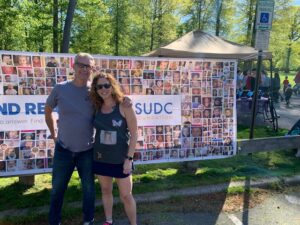
Jonathan and Ellen Young, parents of Casey & Jordan