
15 Oct The Many Truths of Life After Child Loss
Remembering Amy and Finding a Way Forward
In this conversation, Will Carrington, SUDC Foundation’s Writer in Residence and SUDC Dad to Maria, speaks with Beewan Athwal, a mother from the United Kingdom, about her daughter Amy, the years following Amy’s death, and the many truths her family has held along the way. Their conversation explores Amy’s life, sibling grief, the extraordinary challenges of losing a child during COVID, Beewan’s decision to grow her family through IVF, and what it means to continue parenting while keeping Amy an enduring part of their family.
Will: Please tell us about your daughter Amy.
Beewan: Amy was 12 and half years old and really looking forward to finally being a teenager. She was finding her voice and preferences. She loved performing arts, especially anything to do with musical theatre. Hamilton was one of her favorite musicals. She sang in the school choir for the winter showcase and was learning drums and steel pans at school. 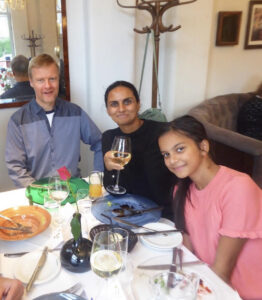
I had brought her an electric drum kit for Christmas, but she died before I could give it to her. I had to have it collected and returned, a present that haunts me as it would’ve brought her so much happiness and so much noise into our house.
Amy was so physical too, swimming regularly for Haringey Aquatics in North London and doing contemporary dance. She moved so well, having started ballet when she was 5 and having a dancer’s posture. She took part in drama workshops outside of school and had an agent. She had parts in the BBC series Humans and various commercial work. She really embraced what life had to offer.
Amy was still young enough for cuddles and to lie her head on my lap when watching T.V. She adored her older brother Jack who had just left for university. Jack had her stay in his student house for a long weekend, and it really inspired Amy and she thought a lot of what she wanted to do at University.
Despite her love for performing arts, she wanted to do Politics, Philosophy and Economics degree as she knew it was a hard degree to get accepted into and there would be more job possibilities afterwards. She told her great Aunt over the phone a few days before she died that she wanted to go study by the sea. She had a lot of aspirations for herself and it’s crippling at times to realize all she has lost and all we haven’t seen her do.
Will: Please tell us about her relationship with her older brother Jack.
Beewan: Jack adored Amy. I think it helped that they were 7 years and 3 days apart. She had the good grace not to be born on his birthday too, which he was really worried about. Jack has always been quiet and like an old man. Amy was much more outgoing, and he quite liked her getting the attention.
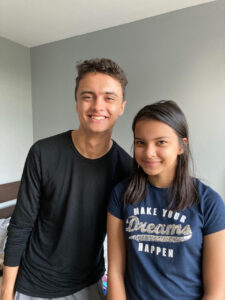
They balanced each other out and also encouraged each other. Amy was the only person allowed in Jack’s room when he was a difficult teenager. They always played well together and mostly liked to play a role play game. They would make up characters and scenarios and then in the back of the car on long drives or on sun loungers on holidays, they would say what their character was doing and the other one would take on the story and it would go back and forth, imaginary play for days. They really understood each other and would make a world for both to explore. They also loved sims and created other worlds there. They had similar hobbies, both swimmers. They were a little team. He gave a eulogy at her funeral and said, “She was his best friend for all of her life.” Our heartbreak for him and well as her is very deep.
Jack was away at University when Amy died. He was in shock and then pure anger that this had happened to her and to us as a family. I reached out to people at his university to help but, because of the COVID lockdown, no one could see him in person, and he refused to answer calls from them. He isolated himself. Just at the point that his adult life should’ve been starting, the worse thing ever had curtailed him. He couldn’t study and his course only offered a few weeks delay in handing in assignments. He ended up taking a year out to figure himself out and during that time he self-sabotaged, survivors guilt maybe?
We were having lots of medical tests, and he was so resistant to them all but did them. We managed to get him to agree to do some therapy as he wasn’t sleeping but he would only agree to CBT as he didn’t want to talk to anyone, maybe it was too big for him, or he wanted to deny it was real. I found a trauma specialist who did CBT and spoke to them about Amy dying and how Jack was coping or not coping. Very quickly the CBT turned into EMDR sessions instead and it helped Jack face the grief and trauma with minimal talking. It shifted things for him and allowed the emotions to come in. We did it as well, and it provided a space in which I could process the trauma.
Jack is still coming to terms with Amy’s death. We have two more little kids that he adores and they adore him, too. He has a steady job and a long-term girlfriend that he lives with. He is now living his life and seeing a future for himself.
Will: While recognizing that all SUDC stories are tragic, what special challenges came with this event happening during COVID?
Beewan: So many challenges. Even on the morning when we found Amy. The Coroners Office couldn’t be reached as they were all working from home, except no one seemed to be working. That meant that Amy’s body wasn’t moved from our home for hours and the police tried frantically to get permission so the ambulance could move her to the hospital.
We had to think of how to get Jack back from Bristol to London as Covid meant travel wasn’t allowed. The police said that they could collect him, but I felt that this would be traumatic as they would just be people in uniform, he’d have to spend three hours travelling with. Luckily my husband’s half-sister drove to get him from her house in Devon and brought him home.
We were only allowed to invite 30 people to Amy’s funeral due to COVID restrictions, even though many more people wanted to attend. We had friends and neighbours line our street the day the hearse arrived and people walked past the hearse to pay their respects. I cried so much, seeing all the support and care. But also, the realization that this was still real. At one point I had to really hold onto my husband as I could feel my legs give way a little with the sheer weight of grief and sadness. We were not allowed a wake under COVID, so we walked with friends and held a little outdoor wake away from prying eyes after the funeral.
We were then very isolated as visitors to houses weren’t allowed in lockdown. Not that I wanted to see anyone, but I do wonder if it may have helped to sit in a bit of reality when I was that raw. The coroners and pathologist meetings were all done via zoom and they couldn’t give us any answers. The NHS was closed down so we had to pay privately for heart checks and consultations until 6 months later when we got transferred into the public system. All therapies for that first year were done via zoom.
We do talk about that first year and how strange the world was and how strange we were. Changed in a moment and trying to figure out our new selves and our new lives. COVID and lockdown also meant that we had to face our grief and trauma with fewer distractions. We were at home and having to think again and again about what we had lost.
Will: Please tell us about your decision to have two additional children who, I must say, are quite adorable.
Beewan: Literally the day after Amy died. I turned around to my husband Adrian and said, “if you expect me to live, I need more children.” His reply was “You’re mental.” I had an absolute longing for a baby. My body was mourning my baby, even though Amy was 12, my body reacted in a bizarre way, almost like it had just finished lactating. I’ve spoken to other bereaved mothers and they have something similar. I was not ready to end my day-to-day motherhood; I was supposed to have 6 more years of Amy in our everyday life. We spoke in family therapy about it and our son Jack said I wasn’t thinking correctly. I probably wasn’t but I knew I needed to have a baby. At first, I think some part of me thought I could magic Amy back into being with having a new baby. But after some time, I knew I just wanted kids to look after and to be allowed to be a care giving mum for longer. Luckily my husband came around to the idea.
We spoke to an in vitro fertilization (IVF) clinic here and we realized the chances were minimal due to our ages. I was 43 and my husband 52. We did one round of IVF, and the embryos didn’t make it to day 5. I was devastated as it felt like I was grieving something new. But I also was a bit relieved as we hadn’t had results back from medical test so didn’t know if we had any heart conditions or issues with our DNA. A phrase the cardiologist used ‘spelling mistake in her DNA’ kept playing in my mind. I spoke to my husband again and said I think we should do double donor, both donor egg and donor sperm. My reasoning was it was more likely to be successful and that would minimize the trauma of IVF rounds. Also, I didn’t want to drive myself or the child crazy thinking that they may die each night as we had no symptoms before Amy died.
I also rationalized that as an Indian I have always learnt about souls and minimizing my own ego. Wasn’t it time for that? I wanted two (yes, I’d decided I need two new kids by then) souls to look after and care for. The body, the vessel, and DNA weren’t important.
This was something new and big for my husband. We had a helpful talk with a friend who had her child via donor egg, but he still needed time to think. Yet I married the right man, and he eventually said yes and that people are capable of loving anyone and anything. So, we set off to do double donor IVF.
We used the same clinic as my friend did in Greece as they were very empathetic to our situation. Our eldest was aware of our decision and by then he supported us as something we needed. We were lucky and got pregnant with Alfie quite quickly. We were referred to the Parent Infant Psychology team who helped us hold the grief and trauma and prepare to have a baby. We still see them now.
When Alfie was born, it was a powerful moment. New hope. Jack cried when he saw him in the hospital and did lots of holding him as he was living at home with us at the time. He really took to him immediately. Alfie is the baby I’d wish on every bereaved parent, he’s so happy, sociable and needs to be outside about 8 hours a day. He’s shifted a lot in our lives.
Daisy was born 19 months later. I needed more help to get used to the idea we were having another girl in our family as Amy was that girl. By the time Daisy was here, we had had a lot of therapy, and it was pure love from all of us. Alfie was the only person to say ‘No’ when they first saw her.
So now we are a family of six, with Amy missing. Holding each other when we need and giving space at other times. Our family is very strong and close, anchored together with love and care.
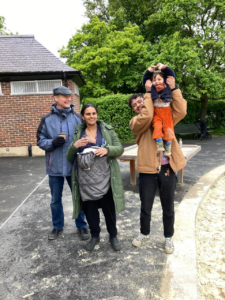
Will: It’s been over five years since Amy passed away. How does being a grieving parent affect how you interact with people?
Beewan: It’s a big part of who I am and I’ve accepted that. I tend to drop the grief/death bomb quite early when meeting new people. I know some bereaved parents hold back, but I really don’t have time to build a relationship with someone who cannot hear about Amy. I also still think I bring something special to a party. I’m still funny, have great stories, wonderful kids and am great company. I’m not apologetic for something others cannot hold. I’ve had people blank out at what I’ve said, but then I just give up on them and move on. Those relationships would only be superficial at best – I need people who can be intimate. I’m a busy mum with a demanding career, and I need people who can meet me where I am. Luckily these people are out there. I’m not part of the big mummy WhatsApp groups; I don’t want to be hanging out with the ‘white-wine mums club’ as they weren’t able to handle me when Amy died. I only want authentic relationships, people I will turn up for, and I know they will do for me, too.